
|
|
||||||||||||||||||


| 2026-2027 Electoral Calendar, latest official version |

|
 |
|
|
|
|
|
|
|||||||
|
|
Haiti - Society : 64% of the Haitian population lives in cities and growth is sustained 14/12/2023 10:07:50
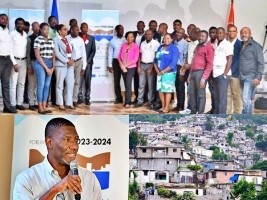
Tuesday, December 12, 2023, a regional Urban Forum for the Great South was held at Camp Perrin at the initiative of the Interministerial Committee for Territorial Planning (CIAT). On the program of this meeting, the sharing of the results of work carried out over the past ten years around the urban question, particularly in certain cities in the Great South (South, Nippes, South-East and Grande'Anse). Another Regional Urban Forum is planned in the North, in Cap Haïtien on December 15. In the preamble, Michèle Oriol, Executive Secretary of CIAT recalled that the Haitian territory has changed. The population increased from 6 to 12 million inhabitants between 1982 and 2020, and it has changed habitat : 40% urban population in 1982, 64% in 2020. These lasting changes require us to rethink the entire territory. Studies from the Urban Research Program (PRCU), data from the Haitian Institute of Statistics and Informatics (IHSI) and the United Nations Population Fund (UNFPA) show that the development of built-up areas dense no longer coincides with the administrative concept of commune where the capital corresponded to the densely built area and where the rest of the commune was rural. In the Great South for example, there are clear trends of linear settlement along the Miragoâne/Fonds-des-Nègres/Aquin road axis as well as along the Enriquillo fault. The urban transition (half of the country's population in cities) took place in 2014. The average annual growth of the urban population remains rapid and the demand for cities is very strong. The expansion movement was sustained. The high speed of development of metropolises constitutes a major challenge, whether in the Great South or the Great North. Without control or support from public authorities, the consequences of spontaneous urbanization raise numerous challenges :
Three regional forums and a national forum will be organized by CIAT in the coming weeks to enable discussion with local and regional stakeholders of the broad outlines of an urban policy defined during field work and meetings with specialists over the last few years. years. "A lot of enthusiasm from academics, more realism from mayors, a general good will to do real things," rejoiced Michèle Oriol at the end of this first Regional Urban Forum. HL/ HaitiLibre
|
|









|
|
Why HaitiLibre ? |
Contact us |
Français
Copyright © 2010 - 2026 Haitilibre.com |