
|
|
||||||||||||||||||


| 2026-2027 Electoral Calendar, latest official version |

|
 |
|
|
|
|
|
|
|||||||
|
|
Haiti - Economy : Critical deficit of nearly US$400 million for Haiti's recovery 10/11/2025 09:09:07
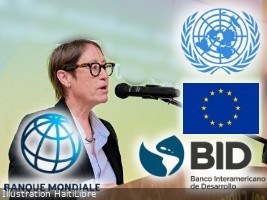
The Government of Haiti, in collaboration with development partners such as the World Bank, the Inter-American Development Bank, the European Union, and the United Nations, has published a revised version of the Rapid Impact Assessment of the Crisis (RCIA) and its investment plan. This revision addresses the evolving security context in Haiti since its initial publication in December 2024 (https://www.haitilibre.com/docs/WB-RCIA-REP-OCT-2024-EN.pdf ), when the plan was valued at US$1.6 billion, to ensure that recovery efforts remain relevant and achievable. Despite this revision, the conclusion of the revised assessment highlights a significant funding gap that threatens the implementation of priority recovery interventions. The updated investment plan estimates the total need for the period 2026–2027 at US$644 million. However, the national budget and current donor commitments cover only about half of this amount, leaving a funding gap of $364 million for the next two years. This shortfall underscores the urgent need for better coordination among donors and innovative financing solutions to bridge the gap and support Haiti’s transition. "Strong coordination among donors can help allocate available resources to investment areas identified as critical priorities," said Anne-Lucie Lefebvre, World Bank Country Manager for Haiti. "Changes in security conditions since the Rapid Impact Assessment of the Crisis were developed do not diminish its importance. On the contrary, as security improves, the assessment remains a crucial complement to restoring basic services, infrastructure, and livelihoods in areas liberated from gangs, in a rapid and coordinated manner." The Security Council resolution establishing the Gang Suppression Force marks a crucial step towards restoring security and stability in Haiti. The creation of the United Nations Support Office in Haiti to provide logistical and operational support to the Force will help translate this commitment into concrete progress on the ground,” said Ariel Pino, Acting United Nations Resident Coordinator in Haiti. He added that “while the Government of Haiti retains primary responsibility for national security and governance reform, a key pillar of the Recovery Framework, the resolution sends a strong signal of solidarity and shared commitment to addressing humanitarian, development, peace, and security challenges.” The RCIA and the investment plan focus on the areas of the Port-au-Prince metropolitan region most affected by the security crisis. They quantify priority needs in four areas: economic recovery and governance; infrastructure; social protection and services; and the rule of law and security, specifying the needs for the transition period. All proposed programs were reviewed for their feasibility in the current security context to identify a subset of interventions that could be realistically implemented, taking into account physical access constraints and operational capacity. To support an effective recovery, partners also developed a Crisis Recovery Framework (CRF) to facilitate the planning, coordination, and monitoring of recovery activities among the government, its partners, and security actors, and to ensure transparent oversight of investments. HL/ HaitiLibre
|
|







|
|
Why HaitiLibre ? |
Contact us |
Français
Copyright © 2010 - 2026 Haitilibre.com |