
|
|
||||||||||||||||||


| 2026-2027 Electoral Calendar, latest official version |

|
 |
|
|
|
|
|
|
|||||||
|
|
The food situation continues to deteriorate in Haiti 18/04/2026 09:56:16
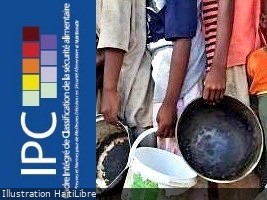
On Thursday, April 16, 2026, the National Food Security Coordination (CNSA) officially presented the latest updated results of the IPC analysis at an event held at the Montana Hotel. From March to June 2026, more than 5.83 million people (52% of the analyzed population) will face high levels of acute food insecurity (IPC Phase 3 or higher). This represents a slight improvement compared to the previous projection of 5.91 million people in Phase 3 or higher in the analysis published in September 2025. Nearly 1.9 million people (16% of the analyzed population) are in IPC Phase 4 (Emergency), which also represents a slight reduction in severity compared to the previous estimate, which projected 2 million people would be in Emergency (IPC Phase 4). However, these limited and localized improvements remain insufficient to reverse the overall trend of acute food insecurity in Haiti. These limited positive impacts include a slowdown in annual inflation, generally favorable winter agricultural conditions, and improved access along some roads. Although inflation slowed (from 31.9% in September 2025 to 22.1% in February 2026), the outbreak of conflict in the Middle East and the blockade of the Strait of Hormuz caused a major disruption to the global food system, with direct repercussions for Haiti. Nevertheless, the period from March to June 2026, which corresponds to the lean season, represents a deterioration compared to the preceding period from September 2025 to February 2026, during which 5.7 million people faced acute food insecurity at IPC Phase 3 or higher. The worsening crisis is a result, among other things, of the increasingly widespread armed violence in the region. Approximately 90% of the Port-au-Prince metropolitan area is now under the control of armed groups. Violence continues to cripple the Haitian economy and restrict the transport of goods and the movement of people, forcing many of the most vulnerable to join armed groups to provide for their families. Hurricane Melissa also struck the south of the country in October 2025, causing torrential rains, flooding, landslides, and destruction in the Grand Sud region (Sud, Grand-Anse, Nippes), the west (around Petit-Goâve and Port-au-Prince), and the southeast (Marigot). The overall economic situation is having an even greater impact on those already affected by the hurricane. Of the 30 areas analyzed, 10 remain classified as Phase 4 of the IPC (Emergency). These areas include two zones in the Northwest Department, three zones in the Artibonite Department (excluding Gonaïves), the Lower Plateau, camps for internally displaced persons, La Gonâve, the HT07 zone in the Southeast (Belle-Anse district), and the poor neighborhoods of Port-au-Prince and Cité Soleil. The rest of the country is expected to remain in IPC Phase 3 (Crisis). Recommended Actions : Emergency Interventions : Given the severity of food insecurity in the areas classified as IPC Phase 4 (Emergency), it is imperative to implement urgent actions. These interventions must prioritize assisting the poorest and most affected households to meet their basic needs, save their lives, significantly reduce their food consumption deficits, and prevent total and irreparable loss of their livelihoods. Livelihood Support : Successive shocks, particularly climatic and economic ones, have severely weakened household resilience. Rapid support is needed to restore livelihoods and productive assets, including through agricultural inputs, livestock assistance, rural credit, material assistance, and cash interventions. These measures are essential to support the spring 2026 agricultural season and help households recover their sources of income. Linking Emergency Response and Development : Limited access to basic services and governance challenges continue to negatively impact acute household food insecurity. Strengthening the linkages between emergency response, development, and peacebuilding efforts is essential to achieve more sustainable and transformative effects on household food and nutrition security and to promote stability in affected areas. HL/ HaitiLibre
|
|









|
|
Why HaitiLibre ? |
Contact us |
Français
Copyright © 2010 - 2026 Haitilibre.com |